
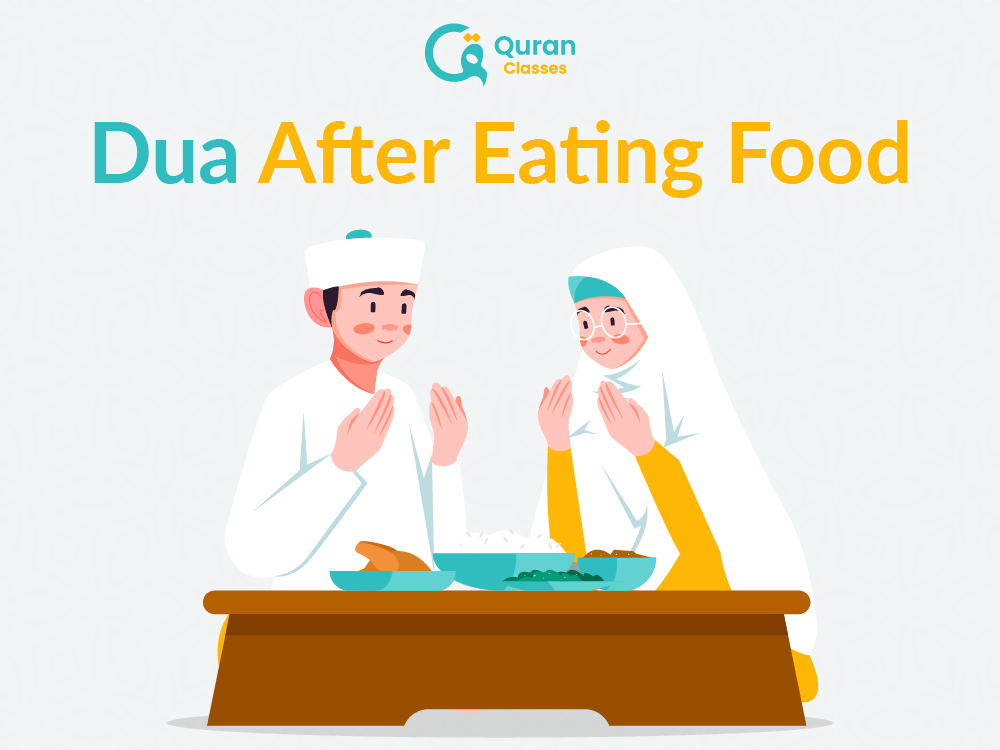
Food is one of the greatest blessings of Allah to humanity. Just as we begin our meals with prayer, Islam teaches us to conclude it with sincere appreciation through specific supplications. The dua after eating serves as a beautiful way to express thankfulness to Allah (SWT) for His countless bounties and seek His continued blessings. The after food prayer shows our dependence on Allah for sustenance.
In this blog, we will highlight the authentic after eating dua in Arabic with translation in English, and transliteration.
The Authentic Dua After Eating Food

It is important to recite dua after eating a meal. There are several prayers that can be offered after finishing a meal. We will provide the most authentic dua after eating food.
Dua After Eating in Arabic
It is recommended to read the islamic supplications in Arabic. The prayer of after eating food in Arabic is written as;
اَلْحَمْدُ لِلّٰهِ الَّذِيْ أَطْعَمَنَا وَسَقَانَا وَجَعَلَنَا مُسْلِمِيْنَ
After Eating Dua Transliteration
The transliteration of the after eating prayer helps you read and memorize it in your own lingual script. Here, we provide you with after food prayer in Roman English.
Alhamdu-Lillahi-l-Ladhi At-amana wa Saqana wa Ja-Alana Muslimin
Dua After Eating English Translation
“All praise is for Allah, who has fed us and given us drink and made us Muslims.”
Additional Authentic Supplications After Eating

الْحَمْدُ لِلَّهِ الَّذِي أَطْعَمَنِي هَذَا وَرَزَقَنِيهِ مِنْ غَيْرِ حَوْلٍ مِنِّي وَلَا قُوَّةٍ
Transliteration
“Alhamdulillah-illadhi at’amani hadha wa razaqanihi min ghairi hawlin minni wa la quwwah”
English Translation
“All praise is for Allah who fed me this and provided it for me without any might nor power from myself.”
This simple yet profound dua encapsulates the essence of Islamic gratitude, acknowledging that all sustenance comes solely from Allah’s mercy and provision.
There is a Hadith that the Prophet (peace be upon him) said;
“Whoever eats food and then says: ‘Alhamdulillah-illadhi at-amani hadha wa razaqanihi min ghairi hawlin minni wa la quwwah’ (All praise is for Allah who fed me this and provided it for me without any might nor power from myself), his previous sins will be forgiven.” (Sunan Ibn Majah 3285)
At-Tirmidhi also reported that the Prophet (peace be upon him) taught this specifically after eating dua as a means of expressing proper gratitude to Allah for His sustenance.
The Prophet Muhammad (SAW) consistently demonstrated gratitude after meals. It establishes this practice as an essential part of Islamic etiquette. His companions regularly observed him reciting the dua after eating food, making it a well-established sunnah (prophetic tradition).
There is another version of the dua after eating food in Arabic.
الْحَمْدُ لِلَّهِ حَمْدًا كَثِيرًا طَيِّبًا مُبَارَكًا فِيهِ غَيْرَ مَكْفِيٍّ وَلَا مُوَدَّعٍ وَلَا مُسْتَغْنًى عَنْهُ رَبَّنَا
“Praise be to Allah with abundant, good, blessed praise. He is not to be thanked sufficiently, nor dispensed with, nor can we do without Him, our Lord.”
Simple Gratitude Expression
For those learning, a shorter after eating dua is also recommended to read this.
الْحَمْدُ لِلَّهِ
“All praise is for Allah”
Completion of the Eating Etiquette
Islamic eating etiquette forms a complete cycle of worship. There are some etiquettes that should be carried out while eating food.
- Beginning with “Bismillah” (In the name of Allah)
- Eating with the right hand
- Concluding with the appropriate dua after eating food
- This comprehensive approach transforms the simple act of eating into an act of worship and remembrance of Allah.
The Significance of After Eating Dua
The dua after eating serves as a constant reminder that our sustenance does not come from our own efforts alone, but through Allah’s blessing and provision. This acknowledgment keeps us humble and grateful, preventing arrogance and self-reliance that can lead us away from spiritual consciousness.
Regular recitation of the dua after eating food in English (or Arabic) strengthens our spiritual connection with Allah. It serves as a moment of pause and reflection, helping us maintain consciousness of Allah throughout our daily activities.
Benefits of Reciting Dua After Eating

Enhanced Gratitude
The practice of saying after eating dua cultivates a deeper sense of appreciation for Allah’s blessings. This gratitude extends beyond food to all aspects of life, creating a more positive and spiritually aware mindset.
Increased Barakah (Blessings)
When we acknowledge Allah as the source of our sustenance, He increases the blessings in our food and life. The dua after eating invites continued divine favor and protection.
Protection from Ingratitude:
Regular practice of these supplications shields us from taking Allah’s blessings for granted, a spiritual ailment that can lead to decreased faith and contentment.
Mindful Eating Practice
The dua after eating food encourages mindfulness during meals, promoting better digestion and appreciation for the food we consume.
Stress Reduction
Taking a moment to express gratitude through the after eating dua can reduce stress and anxiety, promoting overall mental well-being.
Community and Family Bonding
When families recite the dua after eating food in English together, it strengthens family bonds and creates opportunities for spiritual discussion and growth.
Quranic Foundation for Gratitude
The practice of expressing gratitude after eating food finds its foundation in numerous Quranic verses. Allah says in the Holy Quran;
“And He is the One Who sends down rain from the sky—causing all kinds of plants to grow—producing green stalks from which We bring forth clustered grain.”(Quran 6:99)
“So eat from the good, lawful things which Allah has provided for you, and be grateful for Allah’s favors, if you (truly) worship Him (alone).” (Quran 16:114)
These verses emphasize Allah’s as the ultimate provider and our obligation to express gratitude for His provisions.
When and How to Recite the Dua After Finishing Food
- Immediately after completing your meal
- Before leaving the dining area
- While still seated at the table
- In a state of cleanliness and awareness
Common Mistakes to Avoid
When reciting the dua after eating, avoid these common errors.
- Rushing through the words without contemplation
- Forgetting to recite it regularly
- Not understanding the meaning
- Treating it as a mere ritual rather than sincere gratitude
- Not teaching children the proper pronunciation and meaning
Conclusion
The dua after eating food represents much more than a simple tradition. It embodies the Islamic principle of constant gratitude and recognition of Allah’s sovereignty over all aspects of our lives. By incorporating this beautiful after eating dua into our daily routine, we can transform ordinary meals into opportunities for spiritual growth and divine connection.
Learn Islamic Supplications Online
Are you looking to teach your kids the basic Islamic supplications while sitting at home? We can help you. We offer several Quran Courses to help you and your kids memorize Quran and Duas online under the supervision of expert Islamic scholars.

Frequently Asked Questions (FAQs)
Is it necessary to recite the dua after eating in Arabic only?
While Arabic is preferred as it is the original language of the supplication. However, beginners can start with the dua after eating food in English translation while learning the Arabic version. The sincerity of gratitude matters more than the language, though learning Arabic is encouraged for authentic pronunciation and deeper spiritual connection.
What if I forget to say the dua immediately after eating?
If you forget to recite the after eating dua immediately, you can still say it when you remember, as long as it is within a reasonable time after your meal. The key is to maintain the habit of gratitude, even if timing is not always perfect.
Can the dua after eating be said for snacks and small meals?
Yes, the dua after eating food can and should be recited after any consumption, whether it is a full meal, snacks, or even a drink. Islam encourages gratitude for all of Allah’s provisions, regardless of the quantity or type of sustenance.
Is there a specific dua for different types of food?
While there are specific supplications for certain foods like dates or milk, the general dua after eating food in English we have discussed can be used for any type of meal. The Prophet (peace be upon him) used this supplication as a comprehensive expression of gratitude for all types of sustenance.
How can I help my family develop the habit of reciting this dua?
Start by consistently reciting the after eating dua yourself, then gently encourage family participation during shared meals. Create visual reminders, explain the benefits in simple terms, and make it a positive family tradition rather than a forced obligation. Children especially respond well to consistent modeling and gentle encouragement

Farman Ali is an experienced SEO Specialist with more than 6 years of expertise in helping businesses grow their online presence, improve search visibility, and enhance their AI visibility across digital platforms to achieve sustainable growth.
He started his career as an SEO intern at an IT company, where he learned the fundamentals of SEO, keyword research, and website optimization. His passion for digital growth led him to work at a digital marketing agency, where he managed multiple client projects from different industries. There he developed strong skills in technical SEO, on page optimization, content strategy, and AI based visibility, consistently delivering measurable improvements in search performance.
Over the years, Farman has worked with international brands and led successful SEO campaigns that increased organic traffic, improved keyword rankings, and boosted conversions. His expertise covers modern SEO practices including SXO (Search Experience Optimization), AEO (Answer Engine Optimization), and GEO (Generative Engine Optimization). These skills allow him to help brands perform effectively across traditional search, voice search, and AI powered search environments.
Farman’s core strengths include technical SEO audits, AI enhanced visibility strategies, SXO improvement, keyword mapping, and data analysis using tools such as Google Analytics, Google Search Console, SEMrush, Ahrefs, and Screaming Frog. He also specializes in creating content strategies aligned with user intent and search behavior, ensuring that websites not only attract traffic but also convert visitors into loyal customers.
He keeps himself updated with the latest Google algorithm changes, AI advancements, and SEO innovations to ensure that every strategy remains effective and future focused.
Farman believes that SEO is more than just rankings. It is about building trust, visibility, and consistent growth for brands across all digital platforms. His mission is to help businesses strengthen their online presence, gain authority in their niche, and achieve long term success through smart SEO, SXO, AEO, and GEO strategies that align with the future of digital search.